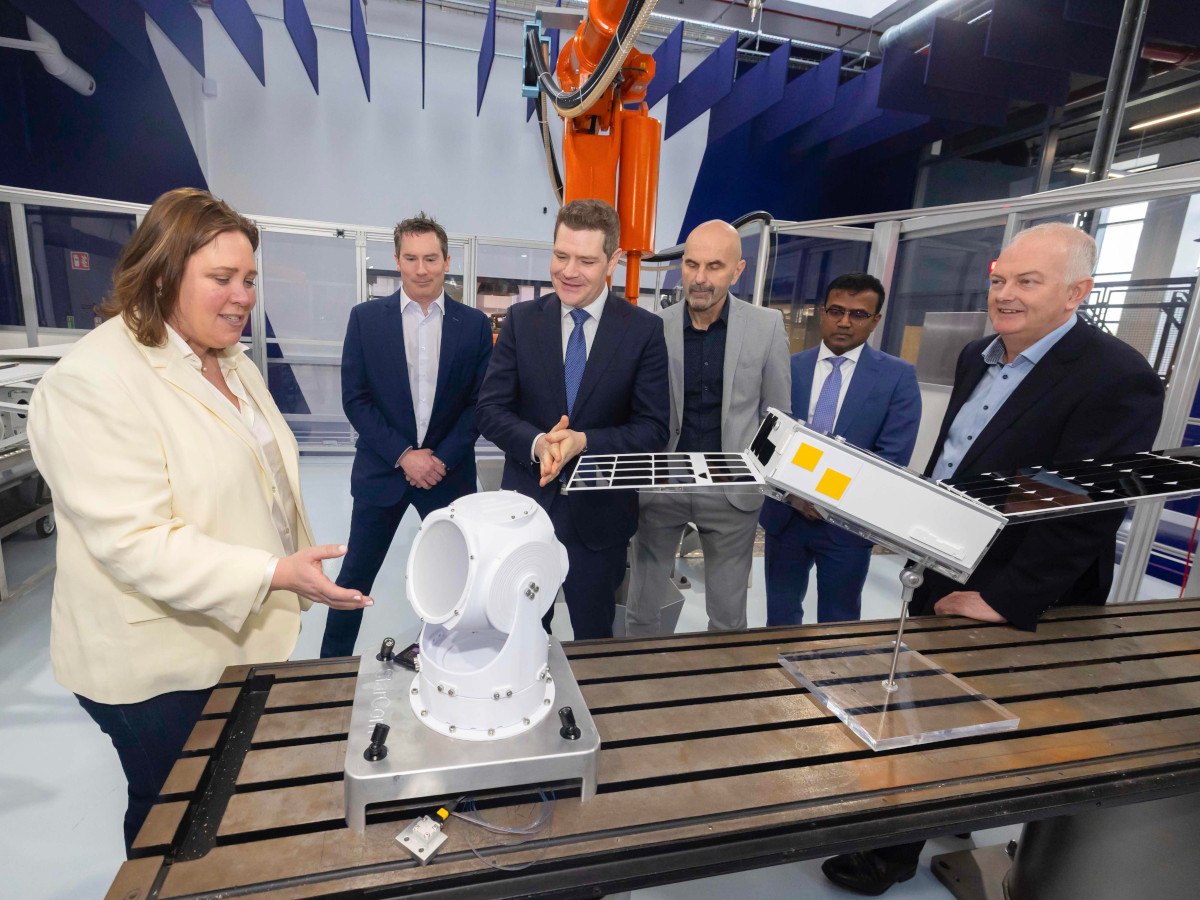
Ireland has launched its first European Space Agency (ESA) Phi-Lab at Irish Manufacturing Research (IMR) in Mullingar, Co Westmeath. The new facility, run in collaboration with the Amber Centre, the Research Ireland Centre based in Trinity College Dublin, is poised to become Ireland’s national platform for space technology development.
The Irish Government has committed to invest €170m into the ESA over the next five years, and the six-year-long ESA Phi-Lab programme is a flagship element of that wider national commitment. The consortium is co-funded by the ESA and Enterprise Ireland.
First announced last June, the ESA Phi-Lab Ireland is one of ten centres across Europe. Together, the labs are attempting to bridge disruptive research closer to commercial needs.
The Phi-Lab network responds to needs from the industry by maturing technologies in advanced manufacturing, materials discovery, AI, quantum and robotics.
Mullingar Phi-Lab to focus on space-enabled innovation
The new Mullingar Phi-Lab is expected to accelerate space-enabled innovation, industrial competitiveness and create new high-value jobs. The Lab was launched today by the Minister for Enterprise, Tourism and Employment Peter Burke, TD, who unveiled a commemorative plaque at IMR’s Advanced Manufacturing Lab. The plaque was produced using a space-grade additive manufactured material mounted on a local piece of 6,500-year-old Irish Bog Oak.
“ESA Phi-Lab Ireland strengthens Ireland’s position, and the midlands region, as a hub for advanced research, innovation and high-value enterprise,” commented Minister Burke.
“It demonstrates our long-term commitment to supporting cutting-edge technologies that will drive competitiveness, create skilled jobs and deliver solutions to global challenges, from advanced manufacturing to industrial transformation.
“The Government’s €170m commitment to ESA over the next five years is about ensuring Ireland plays a leading role in Europe’s space future.”
The Phi-Lab launch comes as the Irish space-tech industry shows signs of rapid growth, with 120 space-active companies currently working with ESA. Meanwhile, an increasing volume of Irish companies are providing technologies and solutions to the commercial space sector globally.
Developing advanced manufacturing, AI and data-driven technology
Barry Kennedy, the CEO of IMR, described the new Phi-Lab as a defining moment for Ireland’s innovation landscape.
“Today marks a significant milestone in Ireland’s space and innovation ambition. IMR is proud to lead the launch of ESA Phi-Lab Ireland, establishing it as a national platform for space technology development.
“This facility positions Ireland at the forefront of European space-enabled innovation, where advanced manufacturing, AI and data-driven technologies can be developed, tested and commercialised for global impact. Ultimately, this is about translating world-class research into real economic and societal value.”
Similar to the Phi-Lab, IMR offers manufacturers a platform to experiment and advance the technologies they use. The organisation offers solutions across automation, robotics, AI and circular production.
Irish space-techs Mbryonics and Ubotica, have been picked out as the first two companies to be supported by ESA Phi-Lab Ireland. The two were selected via an open call put out by the Irish Government
Based out of Galway, Mbryonics specialises in designing and developing photonic satellite communications hardware and software. While Dublin’s Ubotica works to deploy AI technology into space for imaging, data processing and autonomous decision-making.
Announcement also sees launch of second funding Open Call
Following the first call, Minister Burke today (13 February) has launched a second open call that seeks to fund cutting-edge research in Irish industry across materials discovery and testing to the scaled production optimised for space.
The call is looking for projects from space-active companies seeking to advance their position in the European space market or those hoping to bring their innovations to larger terrestrial markets. The call is also open to projects from companies that have previously never considered their products for space.
“With ESA Phi‑Lab Ireland, ESA is investing in the technologies that will elevate the future of Europe’s space sector, strengthening industrial competitiveness while ensuring that innovation for space delivers value far beyond it,” said Dietmar Pilz, the director of technology at ESA, and the head of the European Space Research and Technology Centre.
“It reinforces ESA’s commitment to fostering excellence across its member states and to ensuring that innovation developed for space delivers real benefits for industry, society and Europe’s long‑term competitiveness.”
Philip Thomas, the head of the ScaleUp programme division in ESA’s commercialisation, industry and competitiveness Directorate added, “Through being part of the ScaleUp Phi-Lab network, the ESA Phi-Lab in Ireland is able to help companies in Ireland and across Europe to reach their full commercial potential by providing targeted and relevant support for their most innovative proposals.”